
Primary tabs
Urantiana
Posts
Urantiana webworks in full, latest on top
Page 2 of 13, posts 6 - 10 of 63

Recently, I ran across this graphic in a couple of places:

When I was very young, certain teachings left me with questions. Being very young, these questions were not always well-formulated as I might put them now in retrospect. And being very young, with certain influences discouraging me from asking many of my innocent questions, I suppose I just expected explanations to come later which would straighten things out for me.
There were just things that seemed wrong, which I would now call inconsistent. Everybody likes the dry land, the new beginning, the reassuring rainbow promise part of the story; but that whole wiping out all of humanity because they were bad part: that just didn't seem to jibe, to my young mind, with the loving, merciful, forgiving Father Jesus talked about. It didn't seem like something Jesus would do.
Whenever I had questions about whether God was like this or like that, I kept coming back to Jesus. (A process which continues to serve me pretty well in my seventh decade.) But even stories of Jesus troubled me. That whole thing about the money changers was a special one. I only had a little kid's idealized vision of Jesus, but it seemed, as I'd say today, completely out of character, for one simple reason: He was scary. Jesus was many things, impressive, powerful, commanding, and strict, but none of that is scary. Why was he scary? Because he was angry.
I'd seen my mortal father angry, for example, and that seemed out of character for him. This of course speaks to what is or is not the real "character" of any person, but unbridled anger has always seemed to me to be a character failing. Yet Jesus didn't teach a scary God, and it was hard for my little self to imagine a truly angry Son of God. Strong and righteous, yes, but not angry.
I never asked anybody about it, though, as I recall. It just got filed in a kind of "what th..?" portion of my understanding. Along with a jillion other "what th's."
♥
 What do the historic records actually say? Very little.
And Jesus went into the temple of God, and cast out all them that sold and bought in the temple, and overthrew the tables of the moneychangers, and the seats of them that sold doves, and said unto them, It is written, My house shall be called the house of prayer; but ye have made it a den of thieves.
Gospel of Matthew 21:12-13 KJV, c/o Bible Gateway
Matthew has Jesus clearing the temple, but to whom does "them" refer in "said unto them"? Is he yelling at the folks he's throwing out or is he talking to his followers later?
Matthew closely copies the Mark source, or else both were copying the theoretical Q gospel from which both derive (which source was primarily the "lost gospel" of Andrew, according to Paper 121). The two accounts at least agree on what Jesus said, and generally what he did. However, to whom Jesus speaks is much clearer in Mark. The temple seems to have been cleared by the time Jesus is addressing that remark to his followers:
And they come to Jerusalem: and Jesus went into the temple, and began to cast out them that sold and bought in the temple, and overthrew the tables of the moneychangers, and the seats of them that sold doves; and would not suffer that any man should carry any vessel through the temple. And he taught, saying unto them, Is it not written, My house shall be called of all nations the house of prayer? but ye have made it a den of thieves.
Gospel of Mark 11:15-17 KJV, c/o Bible Gateway
Both accounts agree that Jesus went into the temple, cast out the merchants, overthrew the tables of the moneychangers, and the seats of the dove sellers. Mark adds that [presumably Jesus] "would not suffer... any vessel" to be carried through the temple.
The good chronicler Luke comes along later, but doesn't give even as much detail as Mark. Even more than Matthew, Luke seems to suggest that Jesus is addressing the merchants while he's throwing them out:
And he went into the temple, and began to cast out them that sold therein, and them that bought; saying unto them, It is written, My house is the house of prayer: but ye have made it a den of thieves.
Gospel of Luke 19:45-46 KJV, c/o Bible Gateway
John's Gospel, written long after, doesn't add much but does include a detail which entirely changes the picture and has been the real basis for the historically violent idea of the incident..
And the Jews' passover was at hand, and Jesus went up to Jerusalem. And found in the temple those that sold oxen and sheep and doves, and the changers of money sitting: And when he had made a scourge of small cords, he drove them all out of the temple, and the sheep, and the oxen; and poured out the changers' money, and overthrew the tables; And said unto them that sold doves, Take these things hence; make not my Father's house an house of merchandise. And his disciples remembered that it was written, The zeal of thine house hath eaten me up.
Gospel of John 2:13-17 KJV, c/o Bible Gateway
In John's telling, Jesus took the time to rig a scourge of small cords, and then used this weapon to drive "them" out, "them" presumably being the aforementioned livestock sellers and moneychangers, along with the livestock. Jesus seems to have spared the dove sellers' seats, at least, merely telling them to get lost and saying to them something kind-of like what he is reported to have said in Matthew and Mark. Finally, it's Jesus' disciples who recall something… entirely else. (?)
h/t The Five Gospels Parallels, Edited by John W. Marshall. 1996 - 2001, Department for the Study of Religion, University of Toronto. Includes Gospel of Thomas.
Vast libraries have been written on all the scripture's subjects, and I profess that I have not been a student of anything but the text of the Gospels themselves in researching this. I don't know how scholars interpret the various turns of phrase, in the original languages, or in post-KJV scriptural researches. To this unstudied layman, though, in all cases, Jesus seems to have been reported as acting alone, doing everything himself, and it's usually presumed he did all this in physically violent, if righteous, wrath, what with the scourging and all.
♥
Even when I finally read the Gospels through for myself as an adult, my questions about this were the same. I still wondered, did Jesus really get angry?
MAHARAJJI’S LOVE of Christ was unearthly….
You never knew what a devotee's statement would evoke. A boy came one time and asked, "Maharajji, did Jesus really get angry?”
As soon as Maharajji heard the word 'Jesus,' tears came to his eyes. He was sitting up when the question was asked, and he leaned over on his elbow and tapped his heart three times with tears coming down from his eyes. There was total silence for a moment. Maharajji had brought the reality of Christ into everyone’s consciousness, and he said, “Christ never got angry. When he was crucified he felt only love. Christ was never attached to anything; he even gave away his own body.” And at that point everyone was crying—we had gone through the complete Passion of Christ. And all of a sudden he sat up and said, “The mind can travel a million miles in the blink of an eye—Buddha said that.”
—Told of Guru Neem Karoli Baba in Miracle of Love (Link is to the chapter "Sadhana," pages 317-348 in PDF form at Hanuman Foundation Org.)
Just as Mark clarified the account of Matthew, so do the Urantia Papers reveal a few details that ameliorate the Gospel accounts.
"The Cleansing of the Temple" is the title Bill Sadler Jr gave to section 1 of Paper 173. Dear reader may wish to follow that link and read that section's less-than-a-dozen paragraphs now, as it's too long to quote in full here. Four paragraphs detail the development of the merchandising in the temple court, and how temple visitors, especially those from out of town, resented this profane economy in the holy temple.
"In the midst of this noisy aggregation of money-changers, merchandisers, and cattle sellers, Jesus, on this Monday morning, attempted to teach the gospel of the heavenly kingdom."
Besides the general rabble engaged in commerce, two events are noted as instigating Jesus' actions.
One was an outburst of noise, the simultaneous eruption of an argument at a moneychanger's table and the blaring of a hundred bullocks driven from one pen to another. What a ruckus! The other was observing the taunting of "a simple-minded Galilean, a man he had once talked with in Iron, being ridiculed and jostled about by supercilious and would-be superior Judeans; and all of this combined to produce one of those strange and periodic uprisings of indignant emotion in the soul of Jesus."
And there you have it. Not anger, really. "Indignant emotion." In the soul. Of Jesus.
But before continuing with the account in Paper 173, we have to flip back to Jesus' first visit to Jerusalem, and the temple, as a youth, with his parents. This journey raised and then dashed the spirits of the young son of Israel. Consider what he felt when, "standing on the brink of Olivet, and Jesus saw for the first time (in his memory) the Holy City, the pretentious palaces, and the inspiring temple of his Father. At no time in his life did Jesus ever experience such a purely human thrill as that which at this time so completely enthralled him as he stood there on this April afternoon on the Mount of Olives, drinking in his first view of Jerusalem." UP124§6¶10 Like many mortal children in many innocent circumstances, he learned he was expecting much more than the reality.
Jesus was profoundly impressed by the temple and all the associated services and other activities. For the first time since he was four years old, he was too much preoccupied with his own meditations to ask many questions. He did, however, ask his father several embarrassing questions (as he had on previous occasions) as to why the heavenly Father required the slaughter of so many innocent and helpless animals. And his father well knew from the expression on the lad’s face that his answers and attempts at explanation were unsatisfactory to his deep-thinking and keen-reasoning son.
On the day before the Passover Sabbath, flood tides of spiritual illumination swept through the mortal mind of Jesus and filled his human heart to overflowing with affectionate pity for the spiritually blind and morally ignorant multitudes assembled for the celebration of the ancient Passover commemoration…. UP124§6¶15
This set-up for disappointment is echoed in the next paper:
From the time they left Nazareth until they reached the summit of the Mount of Olives, Jesus experienced one long stress of expectant anticipation. All through a joyful childhood he had reverently heard of Jerusalem and its temple; now he was soon to behold them in reality. From the Mount of Olives and from the outside, on closer inspection, the temple had been all and more than Jesus had expected; but when he once entered its sacred portals, the great disillusionment began. UP125§0¶3
Jesus suffered a cascade of disappointments during the visit. And he had trouble with the explanations for many of the ceremonial activities. "Jesus simply would not accept explanations of worship and religious devotion which involved belief in the wrath of God or the anger of the Almighty." As the visit went on…
Everywhere Jesus went throughout the temple courts, he was shocked and sickened by the spirit of irreverence which he observed. He deemed the conduct of the temple throngs to be inconsistent with their presence in “his Father’s house.” But he received the shock of his young life when his father escorted him into the court of the gentiles with its noisy jargon, loud talking and cursing, mingled indiscriminately with the bleating of sheep and the babble of noises which betrayed the presence of the money-changers and the vendors of sacrificial animals and sundry other commercial commodities.
But most of all was his sense of propriety outraged by the sight of the frivolous courtesans parading about within this precinct of the temple, just such painted women as he had so recently seen when on a visit to Sepphoris. This profanation of the temple fully aroused all his youthful indignation, and he did not hesitate to express himself freely to Joseph.
Jesus admired the sentiment and service of the temple, but he was shocked by the spiritual ugliness which he beheld on the faces of so many of the unthinking worshipers.
They now passed down to the priests' court beneath the rock ledge in front of the temple, where the altar stood, to observe the killing of the droves of animals and the washing away of the blood from the hands of the officiating slaughter priests at the bronze fountain. The bloodstained pavement, the gory hands of the priests, and the sounds of the dying animals were more than this nature-loving lad could stand. The terrible sight sickened this boy of Nazareth; he clutched his father's arm and begged to be taken away. They walked back through the court of the gentiles, and even the coarse laughter and profane jesting which he there heard were a relief from the sights he had just beheld.
Joseph saw how his son had sickened at the sight of the temple rites and wisely led him around to view the “gate beautiful,” the artistic gate made of Corinthian bronze. But Jesus had had enough for his first visit at the temple…. UP125§1
Jesus was not yet thirteen.
♥
Now you have the deeper background for his "indignant emotion," and in particular the background for the actions Jesus took, according to the Urantia paper:
To the amazement of his apostles, standing near at hand, who refrained from participation in what so soon followed, Jesus stepped down from the teaching platform and, going over to the lad who was driving the cattle through the court, took from him his whip of cords and swiftly drove the animals from the temple. But that was not all; he strode majestically before the wondering gaze of the thousands assembled in the temple court to the farthest cattle pen and proceeded to open the gates of every stall and to drive out the imprisoned animals. By this time the assembled pilgrims were electrified, and with uproarious shouting they moved toward the bazaars and began to overturn the tables of the money-changers. In less than five minutes all commerce had been swept from the temple. By the time the near-by Roman guards had appeared on the scene, all was quiet, and the crowds had become orderly; Jesus, returning to the speaker's stand, spoke to the multitude: "You have this day witnessed that which is written in the Scriptures: 'My house shall be called a house of prayer for all nations, but you have made it a den of robbers.'"
It was this excited crowd who cleared the temple, burst out in songs of praise, and "all the rest of that day while Jesus taught, guards set by the people stood watch at every archway, and they would not permit anyone to carry even an empty vessel across the temple courts."
That's how you do it. That's real leadership. Inspiring. Majestic. Electrifying. He knew just what to do, with a sure sense of the crowd, and just how to do it right. Pure political genius with spiritual purpose. That, to me, sounds like Jesus the Son of Man and the Son of God.
The apostles took no part and were stunned by the whole affair, for reasons the Papers relate. There's no telling what influence their lack of involvement, or understanding, might have had on the reports that came down to us through the Gospels. To them, Jesus was taking actions that they considered unexpected and, probably — ironically for my approach — completely out of character for him. He was scary.
While Jesus got to do what his thirteen-year-old self could only have dreamt of doing, both for cleansing the temple and sparing the sacrificial animals, this was more important a teaching than that. It is not a protest against commerce, per se, as many have made it. It is not, as we see, permission for violence, even in "righteous" causes. It is, however, inspiration to strength, resistance to profanation, and assertion of rights by the principled. As the section concludes:
This cleansing of the temple discloses the Master's attitude toward commercializing the practices of religion as well as his detestation of all forms of unfairness and profiteering at the expense of the poor and the unlearned. This episode also demonstrates that Jesus did not look with approval upon the refusal to employ force to protect the majority of any given human group against the unfair and enslaving practices of unjust minorities who may be able to entrench themselves behind political, financial, or ecclesiastical power. Shrewd, wicked, and designing men are not to be permitted to organize themselves for the exploitation and oppression of those who, because of their idealism, are not disposed to resort to force for self-protection or for the furtherance of their laudable life projects.
A vital lesson for our times.
At Liberty's Torch (2016 Jan 29), Francis W. Porretto writes about the incident and some of the "elements the story doesn’t tell explicitly" (but which the Urantia Papers do touch upon). Includes the illustration that heads this article.
•
•
•

•
•



•
•
•
•
•

Tila Tequila

Not Tila
Tila Tequila said insane things about coming interstellar wars and conspiracy theories this week. Let’s try to interpret blares the headline in the Washington Post over a "style blog" 2013 Dec 13 submission by one Caitlin Dewey, a Washington D.C. "social media reporter" who has written for the New York Times and the Atlantic!
Tila Tequila reportedly tweeted, "Dec. 9, 4:55 p.m. Let me tell you a really quick story that will probably make zero sense to you whatsoever but here goes: So in the future there is going to be a huge war for Earth Empire between the Aeon Illuminati, The Earth Soldiers, The Supreme Seraphim, and the Cyborg Faction.”
Yes, what a mish-mash. in "interpreting" this tinfoil-hatted tweet, Caitlin Dewey writes, "'Supreme Seraphim' … are 'the highest of the seven revealed orders of local universe angels,' according to the obscure 'Urantia Book,' a sort of New Age Judeo-Christian spin-off that fervently insists it is not a cult."

Just, never mind Tila Tequila and whatever agitates her. Too many compound conspiracies conflagrating. You can judge for yourself by watching her video about exposing the Illuminati.
However, regarding this "style blogger," I have no idea what previous familiarity Caitlin Dewey has with The Urantia Book, or the various organizations and factions it has generated. Whole seconds may have been consumed searching out the phrase "Supreme Seraphim" and perhaps seconds more to scan a few sites critical of the UB. (No need to click on the links, just read the quips brought up by the search engine.)
That the Urantia revelations are still relatively "obscure," I'll readily grant you, and since I'm a go-slow person, for my taste, it could continue in relative obscurity for a good while. "New Age" is often applied to it, but it's a debatable descriptor for a book ostensibly promulgated in the 1930s and 1940s — if anything, the Papers might be considered as deriving from the spiritual revivalism of the late 19th and early 20th Centuries, but then, so would a lot of what was called "New Age"). While the UB discourses extensively on Judaism and Christianity, and does claim a direct heritage therefrom, theologically it is far more than an eclectic "spin-off."
But never mind such definitional and doctrinal trivia.
Dewey sneered that the "Urantia Book … fervently insists it is not a cult"? That's an awfully dismissive and arrogant attack upon the book and a lot of people to whom its teachings mean a lot.
Religion, science, economics, or politics, the LaughingStock Media types have their tropes and seem to believe there's no need to dig further, nor show anything but the vilest mockery of that to which they think themselves superior. It's unsurprising, then, this easy, denigrating dismissal of all those for whom the Urantia teachings are valuable, especially considering the treatment given those who respect the Bible, much less the Book of Mormon … anything but the Koran, some of whose followers might blow you up if you did.
The folks whom I first encountered in the Urantia Brotherhood of 1974 were just amazingly average, faithful people, like you'd find in many Midwestern congregations across the country. As far as that goes, I was among a a very few … um … blue-jeaned bohemians among the Sunday-best-dressed folks attending, and we few were pretty tame by freaky standards of later years.
In the subsequent forty years, the "obscure" revelation has become much less obscure. The folks who claim the teachings as their religion now include all manner of people and attitudes not so much in evidence back then. Self-styled cult leaders will "interpret" the teachings in ways I consider absurd to dangerous. One fellow precipitated an end-is-nigh episode (fortunately, despite lives ruined, it had a non-climax which was non-fatal to all participants). There are some mystical folks who believe they have "new" messages to add to the original teachings. On and on. Good ol' humanity.
 Throughout all this, stoically poised amidst the brouhaha, is the original book itself, fundamentally unchanged from the day of its original publication, just as unfathomable in its actual origins as it is fathomable (mostly) as a whole teaching. The minor (or not so minor) edits surreptitiously made following the first printed edition have been cataloged (finally). Much has been discovered about the various sources seemingly adapted for the text. Its various statements and implications have been examined in relation to history, anthropology, astronomy, chemistry, and physics. Research of all kinds into this book continues, but whatever we make out of them, the Papers are just themselves, as they've always been.
 I suppose sometimes the obvious must be belabored. The Urantia Book is a book, and not a cult! Anyone can read it for oneself, nowadays even free, online, you lucky youngsters. You don't have to buy anything or believe one single thing anybody else says about it (especially me). Nobody owns it; nobody is an authority on it (except me).
People can be, well, crazy. "Urantia Bookies" are not significantly crazier than average. Any stirring message will excite its wise and foolish followers, and the more stirring the message, the broader the attraction; although both wise and foolish contingents grow, the honking foolish will be the more noticable. With its space-age perspective, lost years of Jesus, alleged celestial authorship, and origins wrapped in mystery — as well describing a complex universe of beings and worlds which readers can obsess over like Tolkien fans with the Lord of the Rings appendices — what's really remarkable is that this book had such a long, strong, solid initial "cult" of people who were mostly non-mystical, and quite reasonable (other than thinking celestials wrote their book). As far as I know, those type of people are still the mainstream, the majority, of the Urantia "movement." Those who claim to speak for the revelation have included some few on the fringe of reason and sanity, but mostly those who try to understand and live these remarkable teachings are average folk, a "cult" only in the sense of any group of people with a devoutly shared interest.
Some factions of folk who vaunt the book may be unhealthy isolationists, even dangerously perverse, just as we see with humankind in every other grouping. But there is nothing secretive, isolationist, or cult-like in the pejorative sense, about the basic Urantia Foundation (well, not anymore, there was a period of time…), nor are the main Fellowship and Brotherhood organizations which have been formed any type of church. Most of the best effort of the "movement" has simply been fostering study of the book, getting people together with others interested in study and discussion, and offering such study guides as have been developed by other readers.
It's a book to be read, to be fathomed if you take the time. That which you derive from it, which you find valuable, if anything, is to be incorporated into your personal spiritual perspective, just like truth wherever you find it. Then maybe you'll want to read with some other folks, see what they might have figured out that you missed in the course of two thousand pages. And soon, you, too, can "fervently insist you're not in a cult."
♦
Additionally, of absolutely no interest to the likes of the world's Caitlin Deweys:
Regarding Supreme Seraphim
"These seraphim are the highest of the seven revealed orders of local universe angels." (Paper 39) For those who care about the incarnation of the Creator Sons which the UB describes, it's of interest that before our local universe Son was incarnate as a mortal on our world, he was at one time a Supreme Seraphim. Supreme Seraphim are involved in the downreach of the Sons and the upreach of evolutionary creatures. Most significantly to us, perhaps, are the group called "court advisers":
The seraphic court advisers serve extensively as defenders of mortals. Not that there ever exists any disposition to be unfair to the lowly creatures of the realms, but while justice demands the adjudication of every default in the climb towards divine perfection, mercy requires that every such misstep be fairly adjudged in accordance with the creature nature and the divine purpose. These angels are the exponents and exemplification of the element of mercy inherent in divine justice — of fairness based on the knowledge of the underlying facts of personal motives and racial tendencies.
•
•
•
•
•
 National Geographic has a short article, DNA From Ancient Site in Spain Reshapes Human Family Tree, posted by Miguel Vilar, 2013 Dec 5. explaining the impact of the sequencing of "the mitochondrial genome of a 400,000 year-old ancient human from Spain."
Now the story has changed and we are scrambling to come up with a new narrative. Is this a different species ancestral to Denisovan, but not Neanderthals? Were there two movements out of Africa before the third and final migration that Homo sapiens took in the last 50,000 years? How many different species of hominids lived in Europe, Africa and Asia in the Pleistocene? And since these beings surely interbred, can we even call them separate species? When the dust settles, a new story of human ancestry will have surely emerged.
The "Denisovan" was only identified three years ago.
In the comments, one "Patrick" wrote on Dec 6,:
Anyone interested in this subject should read The Urantia Book.
There is NO guesswork in it and it explains EVERYTHING about the history of the human race, including where we came from and how we got to where we are, step by step.
I appreciate Patrick's obvious enthusiasm for the Papers, and for the outlines given in the Urantia papers regarding the progression of human development. What first really intrigued me about this strange book, about which I then knew nothing, nor knew any but one person who had read it, were the very papers regarding the later stages of of human beings appearing on our world.
From my forty years of familiarity with the Papers, I deem Patrick may be engaging in enthusiasm-prompted hyperbole, because it would hardly be proper to say the Papers explain "everything." In fact, they explain very little, or give us only the broadest and most general of understandings, as they do in many of the historic and scientific statements. They are specific enough for their purposes, but not detailed in a manner that is much more than a broad guide to our anthropological understandings.
I am no anthropologist, but as I say, this is enough of an area of interest of mine that it was the topic which drew me into the revelation. In ensuing years, with each anthropological theory or discovery of which I've read, I wonder if, and how, it fits (or does not) into the revelation. It may be considered testimony to the generality of the papers' "revealed" anthropology that I have had very little satisfaction of tying a finger bone here and a hominid branch there to the flow of Andonites, Sangiks, Nodites, Adamites, and Andites described in the papers.
As in all other areas, we are the blind men feeling different parts of an elephant, and describing the animal quite differently, while the revelators see from above the whole picture. We pick up a piece of something here, figure some relationship between DNA patterns there, and do the best we can with what chance, nature, time, and ancestors falling into crevices reveals to us from the past. Even with the box-top picture, it's not always easy to see where a piece of a puzzle might fit in, when you hardly have any pieces at all.
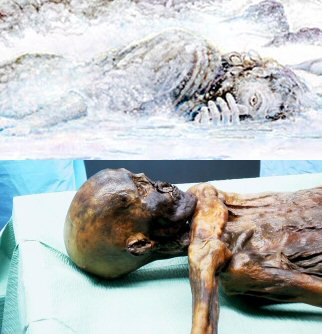
As if to supplant our parental affection for their alteration of the status of Adam and Eve (while keeping the beings themselves, in new legend), the revelators described the first two human beings, Andon and Fonta. Although we are given this carefully-crafted new narrative of the first beings to attain human levels of sentience on our world and suitable attendant celestial ceremony, we are later informed, in Overcontrol of Evolution:
Even the loss of Andon and Fonta before they had offspring, though delaying human evolution, would not have prevented it. Subsequent to the appearance of Andon and Fonta and before the mutating human potentials of animal life were exhausted, there evolved no less than seven thousand favorable strains which could have achieved some sort of human type of development. And many of these better stocks were subsequently assimilated by the various branches of the expanding human species. [Emphasis added.]
Andon and Fonta were unique in being — by lottery as it were — the first spiritual-capacity creatures on Urantia, but they were far from the only possible first. Unless we just happen some day to uncover that very cave in which Andon and Fonta died, we are not likely to be able to pin-point the origins of the Andonites with much accuracy.
Similarly, the entire Sangic race division began, unusually (and from a cynical perspective, unbelievably) in one family, so they tell us:
There were many unique features of the Urantia life experiment, but the two outstanding episodes were the appearance of the Andonic race prior to the evolution of the six colored peoples and the later simultaneous appearance of the Sangik mutants in a single family. Urantia is the first world in Satania where the six colored races sprang from the same human family. They ordinarily arise in diversified strains from independent mutations within the prehuman animal stock and usually appear on earth one at a time and successively over long periods of time, beginning with the red man and passing on down through the colors to indigo.
In the random encounter between fossil-tweazing anthropologists and bits of human remains not obliterated by Nature, in parsing out the fragments of the DNA we understand so little, we might have been lucky enough to be somewhat able to parse out six races had they appeared in different places across eons. It's not likely we'll stumble across a specific half-million-year-old village graveyard containing nineteen distinguishable sets of remains exhibiting six different mutational mainfestations. All we can find is their occasional descendants' remains, widely separated, generations later, partially admixed with innumerable other strains. The Blue man was assimilated into other and later strains, There is nothing but some giantism in some places to suggest the Orange man who were eradicated by the Green, who were themselves absorbed into the Indigo.
Also, Nature is merciless with flesh. Bones can't tell us someone's skin was orange or green.
For anthropological and prehistoric understanding, the most useful information may be the more recent.
The dispersal patterns of the Andites appear to coincide, physically and culturally, with the appearance of the Nordic and Indic Aryans, and possible pockets of Adamic uplift everywhere. These are the troubled troublemaker remnants of the Caligastia rebellion and the Adamic failure, the super-evolutionarily-added elements of humankind, which have no possible evolutionary explanation.
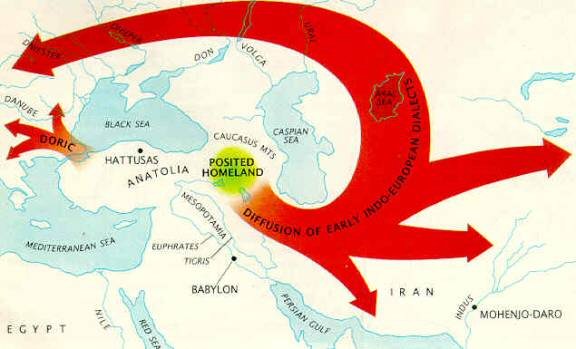
The Nodites may be somewhat naturally explicable as they were, physically considered, enhanced Andonites — some fashion of clone, we might infer, but genetically similar enough to be considered a beneficent mutation from existing evolutionary mortals.
The extraordinarily superior Adamites, however, would appear suddenly 35,000 years ago. Even under the "beneficent mutant" theory, that would be one heck of a beneficial mutation. However modeled on existing DNA it was, it was effectively the mutation from outer space. But, again, we have less and less of human remains to go by as we go back in time; and the relatively small initial Adamite population, while it left a huge footprint on human biology and history, is as subject to merciless Nature as any other population regarding leaving us their biological record. Identifying the early Adamites, as far as I know, is beyond any current anthropological discovery.
They did admix with the Nodites, significantly, and eventually the superevolutionary Andite strains more or less permeated the world's evolutionary populations, which populations themselves continued to mix with one another. We are unlikely to be able to trace backward to anything like a good picture of the millennia-old Adamic origins, given only the utterly blended populations we have today, and the pitifully tiny records we have been fortunate to discover.
As far as I can tell, the Urantia Papers give us mostly information which we could never discover on our own, not for scientific curiosity, although it stimulates that well enough, but for the understanding of our origins, our world's overcontrol and watchcare, from the earliest power controllers, to the resignation of the Life Carriers upon the arrival of human sentience, to the succession of revelations of divine truth.
Perhaps some revealing burial mound under ancient sands will one day confirm some aspects of what the Urantia Papers say about the earliest Adamites, but without something that strong, we will only have the Papers as a broad box-top picture for understanding all the little pieces we get.
•
•
•
•
•
Posted to YouTube by Urantia Now.
•
•
•
•
•