
Primary tabs
Posts
Posts
All articles from all albums, full content, latest on top,
not including Doodles
not including Doodles
Page 91 of 132, posts 451 - 455 of 658
"You can do important work if you do not become self-important; you can do several things as easily as one if you leave yourself out." —An Archangel of Nebadon (Urantia Paper 48)
I recently encountered another episode which demonstrated in a small way the affliction of overmuch self-consciousness. A young friend, in an effusive text reply, clearly mis-read what I had written. I corrected the error. My friend then apologized profusely. No problem, I said, but just take things slow, read twice, I recommended. The reply to something I wrote the next day was a noticably more reserved "OK," which actually didn't even make sense in the context. Knowing this individual's character, I suspect that the reticence of the second incident was in response to the earlier correction, a self-conscious over-reaction to having been found before to be wrong.
Mere correction should be cause for thankfulness, really, but all too frequently the one being corrected feels chided, put down for being in error, and this in turn generates defensiveness, and defensiveness severely complicates learning.
We are all imperfect, while being commanded to be perfect. In this world of "trial and error," wisdom often can only be achieved through learning from error. When one is instructed on what is right, there is intrinsically, inevitably, a certain emphasis upon the fact of having been in error. Correction should be celebrated, as one more step of growth, but the Ego gets in the way. The Ego doesn't want to be wrong, or more correctly, since Ego alone does not have a value system to discern right and wrong, Ego does not want to be found out as being wrong. Being wrong, the Ego imagines, means shame, and invokes guilt, as if one should already have mastered something the first time out, as if mere error were conscious sin.
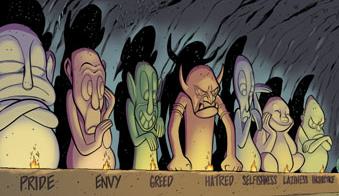
Pride may be the most insidious of the "deadly sins." Most folks can admit that wrath or sloth are unwelcome traits, but Pride defends itself proudly. The reasons for error are essentially irrelevant to correction, but when pride stands in the way of correction, the focus is not on the goodness of correction but on badness of the error, and the Ego, feeling belittled, becomes engaged in defense. "I was only…" "I just meant…" "All I was doing was…" This thoughtless defensive posture not only de-emphasizes the correction, but reinforces the error in the gestalt of the subconscious. Even though the correction may be intellectually acknowledged, rather than the grateful "Aha!" of honest truth-recognition, the emotional memory is more of a disingenuous "oh, yeah?" of self-justification. And all such defensiveness stems from Pride.
Pride thwarts learning, and thus hinders growth. Growth is our goal, with perfection our destiny. Thus, defensive and misplaced Pride stands athwart our path, and threatens us with the opposite of eternal life.
•
•
•

•
•

Sure we believe in liberty except when we don't, says Ann Coulter.
There was a little girl
Who had a little curl
Right on one side of her sneering lip
And when she was Right
She was very very Right
But when she was wrong
It was bullship.
(Okay, okay, so I couldn't come up with a better rhyme on short notice so I munged![[*]](/toolshed/new-window.png) the last line.)
the last line.)
 When Ann Coulter turns her guns on deserving targets, and opens up with both barrels, it's as much fun as it is inspiring to watch her blast open the bull's eye. When she seems to be just putting words together to rattle the enemy by throwing them curve balls, it can be somewhat enjoyable, but not so much. When she's going after what I consider the wrong targets, it's no fun at all, and very sad. I have the same problem with most Right-wing spokesfolk, even (and sometimes especially) Our Leader Mark Levin.
When I tuned to yesterday's column, and saw that she was going to comment on Monday's Republican beauty pageant, I had high hopes of being entertained, and possibly informed (especially since I hadn't watched the "debate"). I was quickly disappointed.
She writes, "Monday night's debate did crystallize for me why I dislike libertarians." Of all political labels, libertarian would probably fit me best. When I first took The World's Smallest Political Quiz, I scored right at the top, although I've discovered the questions keep changing. However, the label is not a comfortable fit for me, not for the sake of libertarianism, but for the reality of most libertarians, so while I'm disappointed at the direction she's taking, I start nodding in agreement when Ann writes she dislikes libertarians ("[e]xcept one, who is a friend of mine and not crazy" she adds parenthetically, with disturbing duplicity).
Then comes the next sentence. "They lure you in with talk of small government and then immediately start babbling about drug legalization or gay marriage." THUMP! That's the sound of my hopes hitting the floor. I have to drag myself through the rest of the column as a matter of duty, but like the time I walked into a relative's house and saw a big poster of Prem Rawat, I knew all too well what lay ahead. Like so many Right-wingers, Ann had stepped right into two of the three tar-babies of the Christian-Republican alliance.
Let me step back a minute to quickly grab some statistics courtesy of Professor Google. According to a Pew Survey for which I find no date, nearly 80% of Americans consider ourselves religious, and over 80% of those are either Protestant or Catholic. For the faithful follower of Jesus, that at first blush seems hopeful. However, according to a Gallup poll from last December, 40% of Americans also "believe God created humans in their present form about 10,000 years ago." For the record, I'm among the 38% who "believe God guided a process by which humans developed over millions of years from less advanced life forms." I find the 40% who are just plain scientifically ignorant to be somewhere between a problem and a serious threat. Between the 40% who don't understand progressive development is scientifically unquestionable, and the 16% who don't think God is involved, reasonable theists are outnumbered. My point with this digression is, believers can be beautiful beings, but they can hold some awfully stupid, and socially dangerous, views. Among those are the Big Three on which liberals consistently capitalize. Now back to Ann, slugging away at two of those tar-babies.
Ann characterizes Ron Paul's answer regarding gay marriage as "a chicken-s**t, I-don't-want-to-upset-my-video-store-clerk-base answer." First of all, disagreement on the issue is one thing, but this seems to unfairly question Paul's sincerity. What Paul said, as quoted in Coulter's column, was, "The federal government shouldn't be involved," and "I don't think government should give us a license to get married." As it happens, this has been my own stance since long before I wrote Defending Common-Law Marriage in 1997. Ann argues that unless the government defines marriage, "courts are going to be bulging with legal disputes among the unalert, who neglected to plan in advance and make private contracts resolving the many legal issues that are normally determined by a marriage contract." The problem is real. However, Ann's arguments are along the same line as a reply I got from a lawyer, and essentially deal with the convenience of the government. I answered those questions in a second article to which the reader can refer for more detail, but the essence is in this sentence (quoting myself seems so odd): "Mary Jo and I have been married for over twenty years, legally, without recourse to State or Church, and since such liberty is feasible, it is not our burden to suggest why it would be a 'hardship' to register with the Gummint, but the Gummint's impossible burden to prove why private marriage contract should not be valid without State approval." I note that, as with any contract, it is up to the individuals contracting to be wise in contracting, and careful to establish their positions in the case of dispute or other reason to turn to the courts. While what I disputed was an Oklahoma legislator trying to do away with Common Law marriage between a man and a woman, the same reasoning would hold in any union, whether between two people of the same sex or even a group marriage. When Ann or others argue against gay marriage as a legal matter, they are, politically and philosphically, indistinguishable from other tyrants who promote government control over everything from our educational systems to our light bulbs.
Covered with tar from that baby, Ann proceeds to use her remaining free extremities to tangle with a second. Freedom from government licensing in marriage, she opines, is "exactly like drug legalization." Indeed it is: a matter of individual liberty uncontrolled by unnecessary legislative tyranny! She characterizes both as trivial. Apparently, she is unaware of how the drug war destroys families, imprisons people for non-transgressions, and is directly responsible for the drug gang violence in Mexico and throughout Latin America. She offers nothing else on the matter, though, so I won't bother to further address her non-existent arguments against this form of tyranny. I will, however, refer the reader to another pair of articles of mine on this subject, also from 1997, on the Constitutionality and social value of Repeal. Most folks who argue like Ann does here seem unaware that the very arguments they use are the ones others employ to fight against second amendment rights, for example.
You know how folks can be. When it's the other guy's ox getting gored, we chuckle, but when it's our sacred cows being attacked, we are disgruntled. So, maybe it's just me, but I find that when Ann has the right targets in her sights, her wit and wisdom make for excellent reading. When she's off-base, she struggles like a liberal to explain her inconsistency. In the end, Ann engages in her special brand of sneering derision and smarmy excess to deride libertarians as "cowering frauds too afraid to upset anyone to take a stand on some of the most important cultural issues of our time." Like the Left who employ the Constitution only when it suits their needs and call it obsolete when it doesn't, too many who should otherwise be true American heroes say they believe in liberty except when their pet tyrannies are threatened. Whether merely egregiously ill-informed, propagandistically disingenuous, or both, Ann is, in this instance, representative of what's really wrong with the Right.
•
•
•
•
•

Without the right moral orientation, the automated car will be as much a tool of tyranny as the mass media have become a tool for propaganda
I foresaw the digital revolution as a powerful force in reversing some of the trends caused by the industrial revolution, specifically the alterations to home and work patterns. Two aspects in particular intrigued me. One was education, the other was transportation. The real technical future of transportation is more like the private car than the bus or train. But without the right moral orientation, the automated car will be as much a tool of tyranny as the mass media have become a tool for propaganda.
My failed college major concerned the ways computers were involved in the future. I saw the digital revolution as a powerful force in reversing some of the trends caused by the industrial revolution, specifically the alterations to home and work patterns. The industrial revolution inherently removed work from home, fathers from families, and families from the land. Two aspects in particular intrigued me.
One was education, which I saw becoming decentralized and more home-oriented, and neighborhood-oriented. You don't have to pack kids off to a huge school many miles away if they can have the best teachers in the world "online" as we now call it. I had envisioned a return to the little red schoolhouse, in a sense, if you had schools at all, a neighborhood resource similar to a library, with world-wide knowledge and educational experts available equally to all. In a sense, this is increasingly possible, even coming to be in some ways, although I admit the intrusion of the Internet so thoroughly into our homes and even our pockets was beyond my vision.
The other was transportation. Much of the reason why people commute to work has to do with "paper-shuffling," and I foresaw the same kind of decentralization of the workplace — and consequently the urban center — that I foresaw in education. The movement to "tele-commuting" and even the "home office" has not been as dramatic as it could be, and will be. Partly this has to do with the technical lag of real-time ability to tele-conference and have different people in different places working on the same documents, "on the same page." Virtual presence will accelerate these trends, I deem, but the inertia of the Industrial Age will take a long time to overcome. The Peter Pans of the workplace actually like it that they get away from family and go to work where they have their self-esteem contests, and that psychology will take time to change. It's coming. It's coming.
I saw that the connected world would mean that human beings could spend less time just going from place A to place B to shuffle paper and make decisions (which also gets into means of direct self-government by involved citizens, which has been developing rapidly), reducing the enormous waste of long commutes with all the attendant problems of traffic, pollution, and parking. But I also saw that the automobile as we know it would be replaced. This has not even begun.
I've lived in the future all my life. At Disneyland I rode the monorail and talked on a (crude but working) videophone, and at the NY World's Fair I had my hands on a computer terminal in 1964. But I'm from the wide-open prairie, and from the mid-20th Century where people "loved" their cars. I didn't see mass transportation as a serious option. People like their rides, for good reason. What I foresaw, and foresee, is the automated automobile. What they are working on these days, high-speed mag-lev trains, and self-driving, self-parking cars are all wrong-headed, but are developing the technology that will be used in the real thing when it arrives. The real technical future of transportation is more like the private car than the bus or train. There are myriad problems to be worked through to arrive at a truly automated transportation system, and as with any human system there will be serious problems, but the advantages will transform society and change everything about how we think of travel.
Imagine getting into your "car" the way you walk into your home office. You "dial up" (isn't anachronistic language fun!) your destination the way you currently link to a webpage. Then, you are a passenger, free to sleep, read, write, or do what teenagers will inevitably do (oh my!). The incalculable lost hours spent steering a car will be returned to us. The threat every person faces driving down the road will be, not gone, but infinitely less. The traffic cop, the stoplight, the gosh-awful traffic circle they're putting in at Price Road and Silver Lake Road, all such nonsense will disappear. The boon is incalculable.
As in all things, though, the spiritual is what matters. Without the right moral orientation, the automated car will be as much a tool of tyranny as the mass media have become a tool for propaganda, and make it easier to put a "car-bomb" in strategic places. The potential for tyrannical use of the system was excellently illustrated in Robert Heinlein's masterwork, Stranger in a Strange Land. In the future Heinlein envisions, one of the central characters is a reporter who has dirt on a political bigwig. (I think this is how it goes — been a long time since I read it.) At one point, the fellow hops in a "taxi" — an automated single-passenger vehicle. Some weeks later, he comes back, having had his taxi hijacked by the politician's goons. Nobody had to jump the car, hold a gun to him, or do anything but re-route the taxi's destination electronically! This will have to be anticipated just as we now have virus-protection software and otherwise fight the battles for cyber-turf.
I still look forward to all the benefits of our digital and automated future. My coffee pot starts on-schedule. I control the house lights and some appliances (for some thirty years now) by remote control. I am delighted daily by the availability of the world's knowledge and news and all the mighty power of the home computer for work and play. The threat to liberty is increased with technology. with better weapons and better eavesdropping and all the rest. Just as the Constitution is worthless when 70% of the electorate doesn't even know what it is or what it says, all the advances in the world won't make any difference if people aren't prepared to defend — and respect — true liberty.
I'd like to think that the good I see on-line represents that future. Mass media are on the decline while voices of liberty increasingly have access to the "press." Tyrants try to regulate and limit our communication but freedom-fighters find ways around their barriers. The old guard tries to keep control over the dollar while a whole new economy grows outside their ability to manipulate. The domination of the educational system by a clot of elitist tyrants is opposed by an entirely superior approach to access to — and evaluation of — knowledge. At root, though, it is a matter of spirituality. Without that respect for one another that derives from the Almighty, the devil wins. With God, of course, all things are possible, so that's where I'm placing my bet. I only bet on sure things.
•
•
•
•
•

When I began pondering the question of determinism and free will, I found myself, philosophically and theologically, going back and forth.
Many years ago, we read this, upon which we've often reflected:
In the question of nature v nurture:
Parents of one child believe it's all environment.
Parents of more than one child understand, it's all genetics.
I'm sure you get it, but to belabor the point anyway because I suffer from prolixism: the former take all credit or blame, depending on the results, the latter recognize that given the same approximate upbringing, one can get radically different results.
Certainly has been something we think about a lot as parents of fraternal twins! (If other parents have yet to fully appreciate this, so far having nothing but wonderful darling little ones, wait until you've shepherded all the offspring to adulthood. But then, it may be God's will all yours will remain trouble-free and you can take all the credit. While thanking God of course. Lest my humor be misunderstood due to deadpan delivery, please note: :-^ tongue in cheek.)
There are determinists among scientists and determinists among religionists. There is room for free will in quantum physics, though, and some religionists hold that we are the free-will children of the God of free will, even that free will may be the primary way in which we are created "in His image."
When I began pondering the question of determinism and free will, I found myself, philosophically and theologically, going back and forth.
On the one hand, the omnipotence and omniscience of the Almighty, that God knows the end from the beginning, that God cannot be surprised, augers for the theologies which favor election (and rejection). On the other hand, if there is no free will, how are we aught but automatons? That the Creator is in absolute control of the entire Creation can't be questioned, yet if the Creator chose to grant to the creature true spiritual liberty, full and free choice regarding eternal destiny, that also can't be questioned. (The limited time-frame of the earth-life for the full presentation of the eternal choice has incited ameliorating possibilities, reincarnation in the East, purgatory in the West, but merely extending the question to one type of after-life or another does not affect the basic dilemma under consideration.)
We are raised — in the modern West at least — with the rejection of old conceptions such as the divine right of kings and with the acceptance of the right of personal liberty. We recognize that one may be mentally incapacitated, truly incapable of recognizing right and wrong, but we assume, socially and in our courts, that, otherwise, people are freely choosing. (Otherwise, we would be like those tyrannies where both the thief and the political dissident are considered "insane" and are alike sentenced to "re-education.") However, in religion, such libertarianism and individualism might seem truly the endowment of our Creator as the revolutionary wrote, or could be construed to be more like the diabolical rebel angel who contested the God-centered universe. A philosophically distressing dilemma to ponder.
Perhaps the best clarity I've had on the matter is this simple comparison with the mortal parent: A mere human parent may know the child well enough to predict what choice the child will make. This in no way abrogates the free will of the child, but it does acknowledge that we choose according to our nature and training. If we as material parents can be so foreknowing, we can extrapolate that our divine Parent can, indeed, grant us true freedom of choice, yet foreknow how we will choose. In the end, I can't do better than that, except to confess that the divine power and prerogative makes such conundrums practically beyond our comprehension.
Therefore, I have long since concluded — not too surprisingly considering my own sometime artistic bent — that I am…
…a Calvin & Hobbesian.
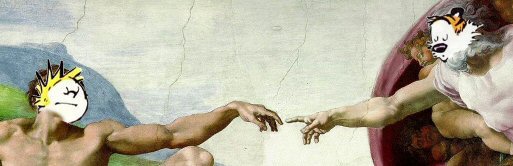
A Mindful Original Remix
Supplemental viewing (added 2011 Sep 2):
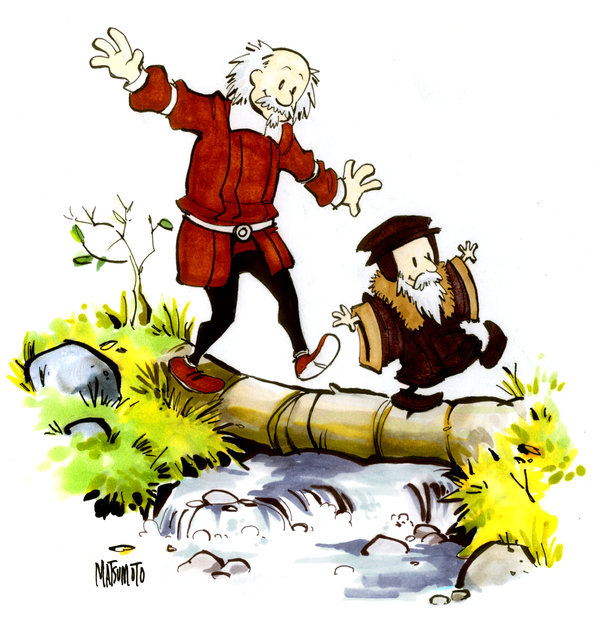
John Calvin and Thomas Hobbes by Spacecoyote
after Watterson, of course
Linked from Robin Parrish at Forever Geek
Linked from Alan Gardner at Daily Cartoonist
John Calvin and Thomas Hobbes by Spacecoyote
after Watterson, of course
Linked from Robin Parrish at Forever Geek
Linked from Alan Gardner at Daily Cartoonist
•
•
•
•
•
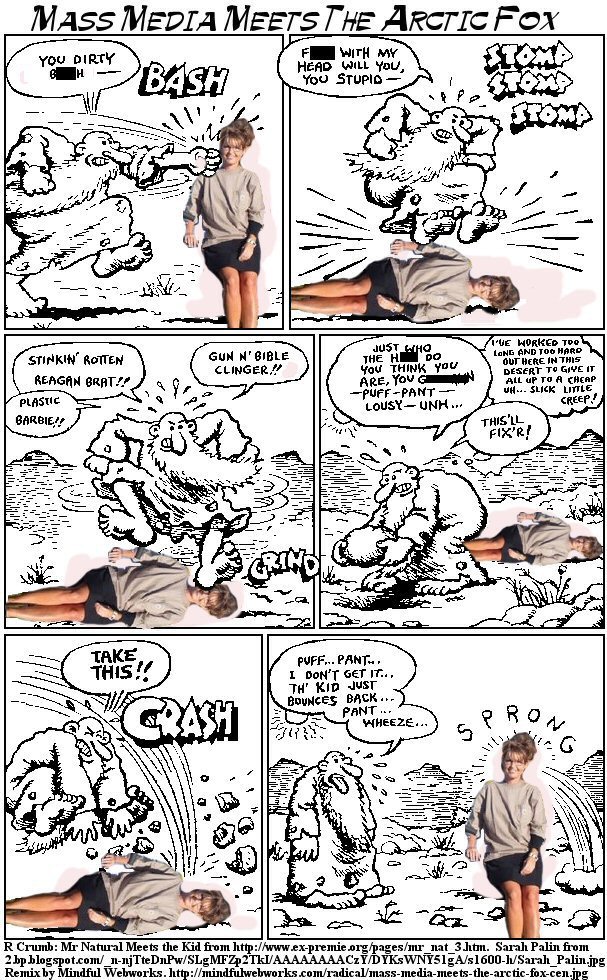
Also available uncensored.![[*]](/radical/mass-media-meets-the-arctic-fox-raw.jpg)
I've been thinking of doing this for some time now. I was inspired to act in honor of the Washington Post and NY Times and all the wolves stalking Caribou Barbie, and before the Bilderbergers manage to shut down internet bloggers and cancel artistic license.
and NY Times and all the wolves stalking Caribou Barbie, and before the Bilderbergers manage to shut down internet bloggers and cancel artistic license.
Remixed from the long-ago cartoon by R. Crumb, "Mr. Natural Meets the Kid" from Zap Comix #7, 1974. Freely offered. Irony alert: Crumb's original six-page cartoon seemed to be favoring Prem Rawat, a.k.a. Maharaji, as "God." No comparison is intended between the huckster guru and Sarah "the real deal" Palin — Crumb's work was just a great page for this purpose.
•
•
•
•
•